
Documents & Compliance
Know what is valid, what is expiring and where the evidence is
RevoHR keeps worker documents, certifications and expiry dates connected to the worker record, warns you before a certification lapses, and keeps the company's policies in one library the workers can actually ask questions about.
- Worker documents and certifications
- Expiry dates tracked on the record
- Company policy and document library
- Training, document and attendance evidence in one place
A certification is useful only if you know whether it is still valid
The document and its expiry date sit on the worker, not in a folder named after them.
Each worker record has a Documents tab. A document is uploaded with a type, and where it is a certification it carries the certification name and the expiry date that drives the warnings.
After the upload, RevoHR reads the document and tries to find the expiry date and the certification name itself. The document moves from pending to processing to suggested, and a review panel appears pre-filled with what was found. Nothing is written to the record until someone confirms it.
That is deliberate. An extracted date that nobody checked is worse than no date at all, because the whole point of the field is that you can rely on it.
What goes on a worker record
- Contracts
- ID documents
- Certifications, permits and licences, with an expiry date
- Anything else you need attached to the person
See expirations before they become tomorrow's problem
Expiry dates are colour-coded on the worker record: red once a document has expired, amber while it is inside the warning window. RevoHR warns you before a certification lapses rather than after somebody notices on site.
The operational difference is small and it matters: a renewal you start three weeks early is an administrative task, and the same renewal discovered on the morning of a shift is a staffing problem.
The three states, drawn as an illustration — not a screenshot
Expired
Red on the worker record. Whatever the document authorised, it no longer does, and the renewal is already late.
Inside the warning window
Amber. Still valid, and close enough that the renewal is an administrative task instead of a phone call on the morning of a shift.
Valid
No flag. The date is on the record, so the next warning arrives without anyone having to diarise it.
Keep the document with the worker it belongs to
A certificate in an email folder is evidence nobody can find under pressure. Attached to the worker record, it sits beside that person's attendance history, their leave, their training results and their WhatsApp thread — which is the combination anyone actually asks for.
Where a leave policy requires documentation, the same principle applies to the request: a medical certificate stays attached to the leave request it justifies.
Company policies go in a library, and that library is what answers questions
This is not the same thing as a worker's documents. Handbooks, procedures, guidelines, forms, templates and compliance documents go into a company library, each with a category and a status, up to 50 MB per file. Nothing in it belongs to one person.
What the library is actually for is retrieval. After the upload RevoHR indexes the document so the assistant can answer from it, and the status column shows that work in progress. Updating a policy archives the previous version instead of deleting it, so the historical record survives.
The library is the knowledge base behind HR Q&A in WhatsApp. It is not where a worker's contract or certification lives — those sit on the worker record, with their expiry dates.
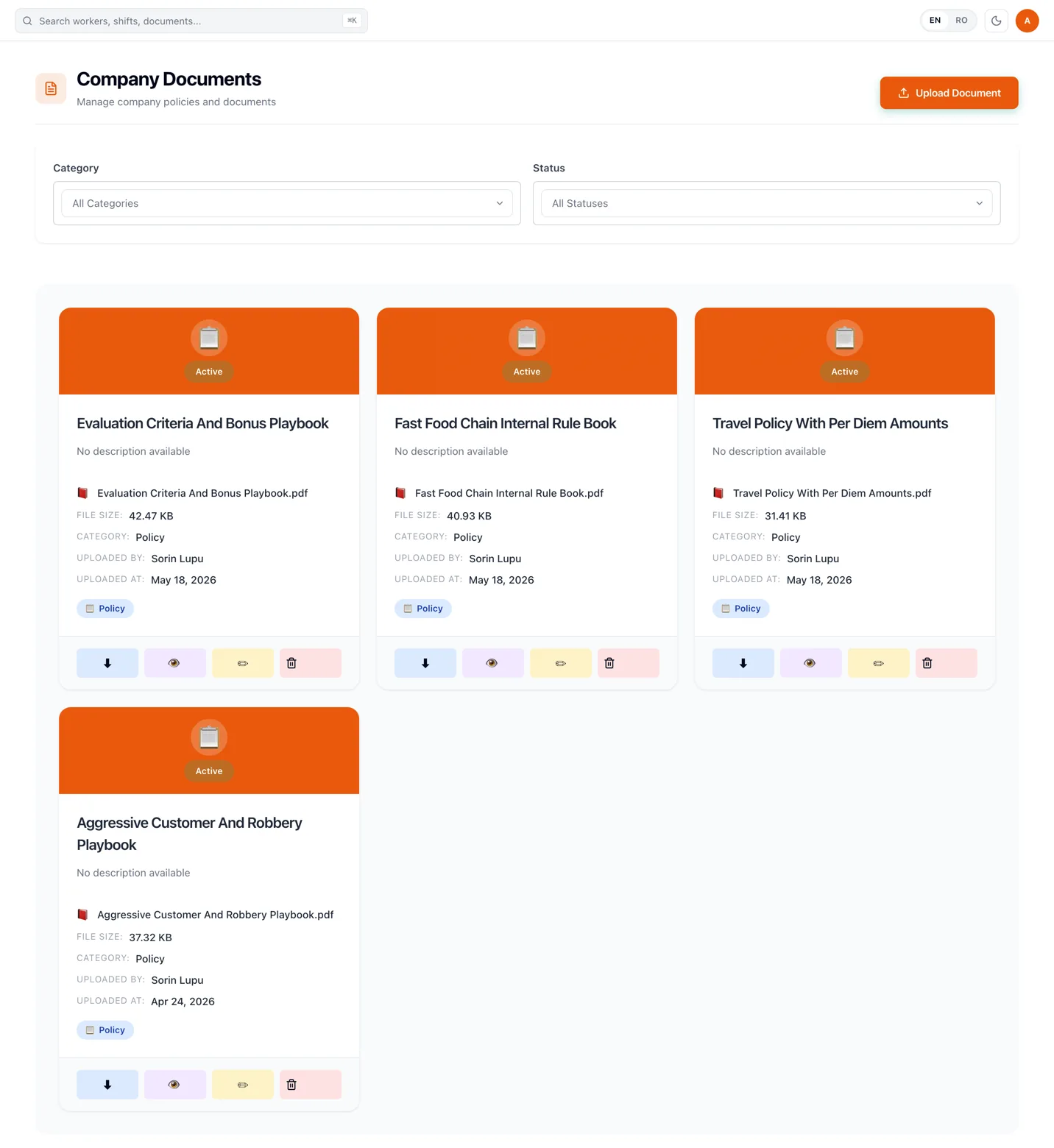
Adding the document is the whole setup
Emailing a PDF to 300 people is not policy distribution. A worker asks a plain-language question in WhatsApp — how much notice do I need to give for holiday — and the assistant answers from your own documents, in the worker's language, naming the document the answer came from. There is no separate knowledge base to write and maintain beside the documents the company already has.
Two behaviours are worth knowing. A document shared with a worker expires after 60 minutes, so a link forwarded outside the company does not stay open. And the assistant answers from what is in the library, which means an outdated handbook produces confidently outdated answers.
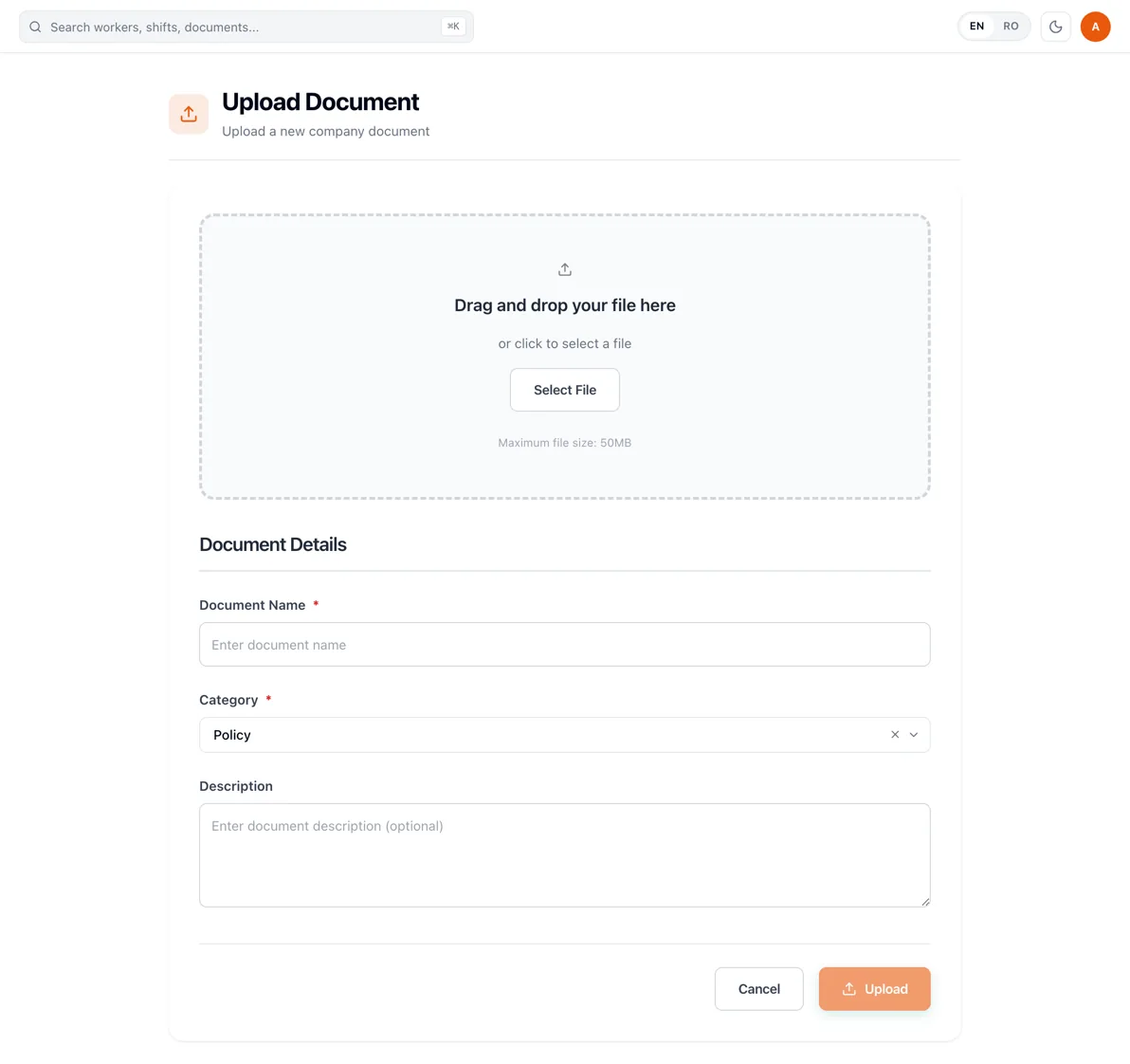
Training, certifications and attendance in one place
Whether a worker is cleared to be on site is rarely one field. It is usually a training that has to be completed, a certification that has to be in date, and attendance records that have to exist for the days in question.
RevoHR brings those together: training completion, certification status and attendance evidence in one place, for one worker or for a whole client's workforce. Nothing has to be assembled in advance, because all of it is already recorded against the same people.
For staffing companies, requirements are client-specific
A client site often has its own induction, its own mandatory training and its own document requirements, and the same worker can be deployed across more than one of them over a year.
Because the requirement is tracked against the worker and the worker carries their location and team, the evidence for one client's site can be read off the same records rather than kept in a separate file per client.
Which document matters depends on the site
Operational examples
Manufacturing
Machine and equipment authorisations, with the expiry date that decides who can run the line tomorrow.
Construction
Site inductions and equipment certificates for crews that change project every few weeks.
Hospitality
Health and food-safety certificates, where the question is who is still valid for tomorrow's shift.
Staffing & outsourcing
Work permits and client-specific inductions, held against the worker rather than in a folder named after the client.
What this replaces
| Current process | RevoHR approach |
|---|---|
| Expiry dates kept in a spreadsheet | Expiry tracked against the worker's own document |
| Certificates in an email folder | Document attached to the worker record |
| Policy PDFs spread across drives and inboxes | One library, indexed so the assistant answers from it |
| Training proof checked separately from documents | Training, certification and attendance evidence in one place |
| Client evidence assembled by hand when asked | Records already carrying site, team and status |
Documents are only as useful as they are current
That is true of a handbook the assistant answers from and of a permit on a worker record. Both are worth keeping in the system that is already being used every day, rather than in the one somebody remembers to open.
Related product pages
Frequently asked questions
- What kinds of worker documents can RevoHR track?
- Contracts, ID documents and certifications, permits or licences, plus anything else you need attached to a person. Each document carries a type, and a certification also carries its name and expiry date.
- Can RevoHR track expiry dates?
- Yes. The expiry date sits on the document on the worker's record and drives the warnings. Dates are colour-coded — red once expired, amber inside the warning window — and RevoHR warns you before a certification lapses.
- Does RevoHR help fill in the expiry date?
- Yes. After an upload RevoHR reads the document and suggests the expiry date and certification name it found. The suggestion appears in a review panel and nothing is saved to the record until someone confirms it.
- Can company policies be stored in RevoHR?
- Yes. Handbooks, procedures, guidelines, forms, templates and compliance documents go into the company document library, each with a category and a status, up to 50 MB per file. Updating a policy archives the previous version rather than deleting it.
- Can those documents be used for multilingual HR Q&A?
- Yes. Uploaded documents are indexed so the assistant can answer from them. A worker asks a question in WhatsApp in their own language and the answer comes back in that language, naming the document it came from.
- Does the compliance view mean RevoHR guarantees legal compliance?
- No. RevoHR brings training completion, certification status and attendance evidence into one place so HR can see where things stand. It does not replace legal advice and it does not determine whether your company complies with every applicable law.