
Open platform
Your data stays yours, and the systems that already work keep working
RevoHR is built to connect, not to lock you in. Everything the platform records about your workforce can leave it, and the tools you already run can talk to it. We treat that as the point, not as a favour.
- Your data leaves in standard formats
- The systems you run today can stay
- Onboarding, hours and reporting stop being manual
- Connections built by us, your team or a third party
Most HR software is built to keep you inside
You know the pattern. Getting your own numbers out means a support ticket, a paid professional services day, or an export that arrives in a format nobody can use. Connecting a system you already paid for turns into a project that never quite gets approved. After two years, the reason you stay is not that the software is good. It is that leaving costs too much.
We decided early that we did not want to compete that way. A platform that has to trap you is telling you something about its own confidence.
You should be able to get it out, connect it, and act on it, without asking anyone for permission. Privacy Policy.
What being open actually means here
Three commitments
What we already produce is yours to take
Attendance, hours, leave, training completion and documents, in standard formats your team and your auditor can open. No support ticket and no professional services day to get at your own numbers.
Your other systems can connect
Payroll, reporting, access control, an internal tool someone built years ago: if it needs the workforce record, it can have it. Your own people can automate against it without waiting for us.
We help rather than obstruct
When a client wants to connect something, our answer starts with how, not whether. That is a deliberate commercial position, not a support mood.
Built so that work stops being done twice
Most of the administrative cost in HR is not decisions. It is moving the same information between places by hand: copying hours into payroll, retyping a leave request, chasing who has completed a training, rebuilding a monthly report from three sources because none of them agree.
A platform that connects removes that layer instead of adding to it. The record is captured once, and everything that needs it reads from the same place.
This is why we care about being connectable rather than merely exportable. An export tells you what happened last month. A connection stops the work from being created in the first place.
Three things worth automating first
- An expiring certification does not just get flagged, it gets acted on: the manager is alerted and the refresher course is scheduled, instead of a date sitting in a list until someone reads it
- Verified hours reach payroll on their own each period, rather than being exported by a person and emailed to another person who imports them
- The weekly picture of planned against actual goes where decisions are made, instead of being rebuilt by hand when someone asks
The day someone joins, and the day they leave
Onboarding is where duplicated work is worst and most visible. The same person is typed into the HR system, then into payroll, then into whatever tracks training, then into the access system. Every copy is a chance to get a name, a start date or a job title wrong, and while the copying happens the new hire is standing there without access to anything.
Offboarding is the same problem with a longer tail, and it is the one that carries risk. Someone leaves on Friday and stays active in three systems until a person remembers to remove them. They keep an open training assignment. They are still on next month's shift plan. Nobody is quite sure which documents were returned.
A connection turns both of these from a checklist into something that happens on its own.
What a connected onboarding looks like
- A new hire created in your HR or payroll system becomes a worker record here, without anyone retyping it
- They get their welcome on WhatsApp in their own language on the first day, not when someone gets round to it
- The training their role and site require is assigned automatically by standing rules, instead of depending on someone remembering which courses apply
- When a role changes or a person leaves, assignments that no longer apply are surfaced rather than quietly staying open
- The leaving date arrives once, from the system that owns it, instead of being announced in four places
Planned hours against actual hours, per shift and per site
Labour is usually the largest controllable cost in an operation, and the one measured last. The plan said forty people across three sites this week. The figure that arrives at month end says something else, and by then the week it came from is long gone and nobody can explain it.
RevoHR holds both halves of the hours comparison, because it holds the plan and it holds the attendance. For a given week you can see planned hours against actual hours per shift and per site, and the two figures that usually explain the gap: people who were scheduled and did not work, and people who worked without being scheduled. Every total opens into the individuals behind it.
What RevoHR does not hold is what each person is paid. Salaries live in your payroll system, and we are not going to pretend otherwise. But the hours are the hard part to reconstruct, and they are the part we have. Put them next to the rates your payroll system already knows, and the cost analysis your finance team currently assembles from several spreadsheets becomes a straightforward join between two systems.
That is the practical case for an open platform, stated plainly. Not that one vendor should own everything, but that the data each system genuinely owns should be able to meet.
What that changes
- The variance in hours is visible during the week it happens, not after the month closes
- A total opens into the people behind it, so a conversation about hours is a conversation about specific shifts
- Repeated overtime on the same shift stops looking like bad luck and starts looking like a plan that needs changing
- Combined with the rates from payroll, the cost view your finance team wants stops being a manual spreadsheet exercise
Ask for the change in plain language, and have it happen
Most software makes you learn where things are. You want next week covered at the Cluj site, so you open the platform, find the right screen, remember which button creates a rotation, and repeat the clicks you did last month.
RevoHR can also be worked through the AI agents your team already uses, such as Claude, ChatGPT or Gemini. A manager describes what they want in their own words, and the agent does it in the platform: build next week's shifts the way last week was built, put these four people on the Saturday night rotation, tell me who is not scheduled on Friday. The work happens in RevoHR, against the same rules and the same records as if someone had clicked through it.
These are not the AI agents RevoHR runs inside the platform. Those work for your employees, answering questions about policy and procedure in the worker's own language. The ones here work for the people who run the operation: HR, site managers, and whoever looks after the system.
This matters most for the people who manage the operation rather than the software. A site manager who schedules once a week should not have to relearn an interface every time, and the request is usually easier to say than to click.
What this changes day to day
- The manager describes the outcome instead of navigating to it
- Repetitive setup, like rebuilding a rotation that barely changes week to week, stops being manual
- A question about next week gets answered without anyone opening a report
- The person still decides. The assistant carries out what it is asked, in the platform, where the record stays
Already have something that works? Keep it.
Plenty of companies already have access control at the gate, a payroll system that does its job, or a reporting tool the board is used to. None of that needs replacing for RevoHR to be useful.
Access control tells you who came through the door. It was never built to handle a leave request, deliver training in a worker's own language, warn you before a certification expires, or answer a question about company procedure. That is the part RevoHR covers, and the two can share the same workforce record rather than maintaining two versions of the truth.
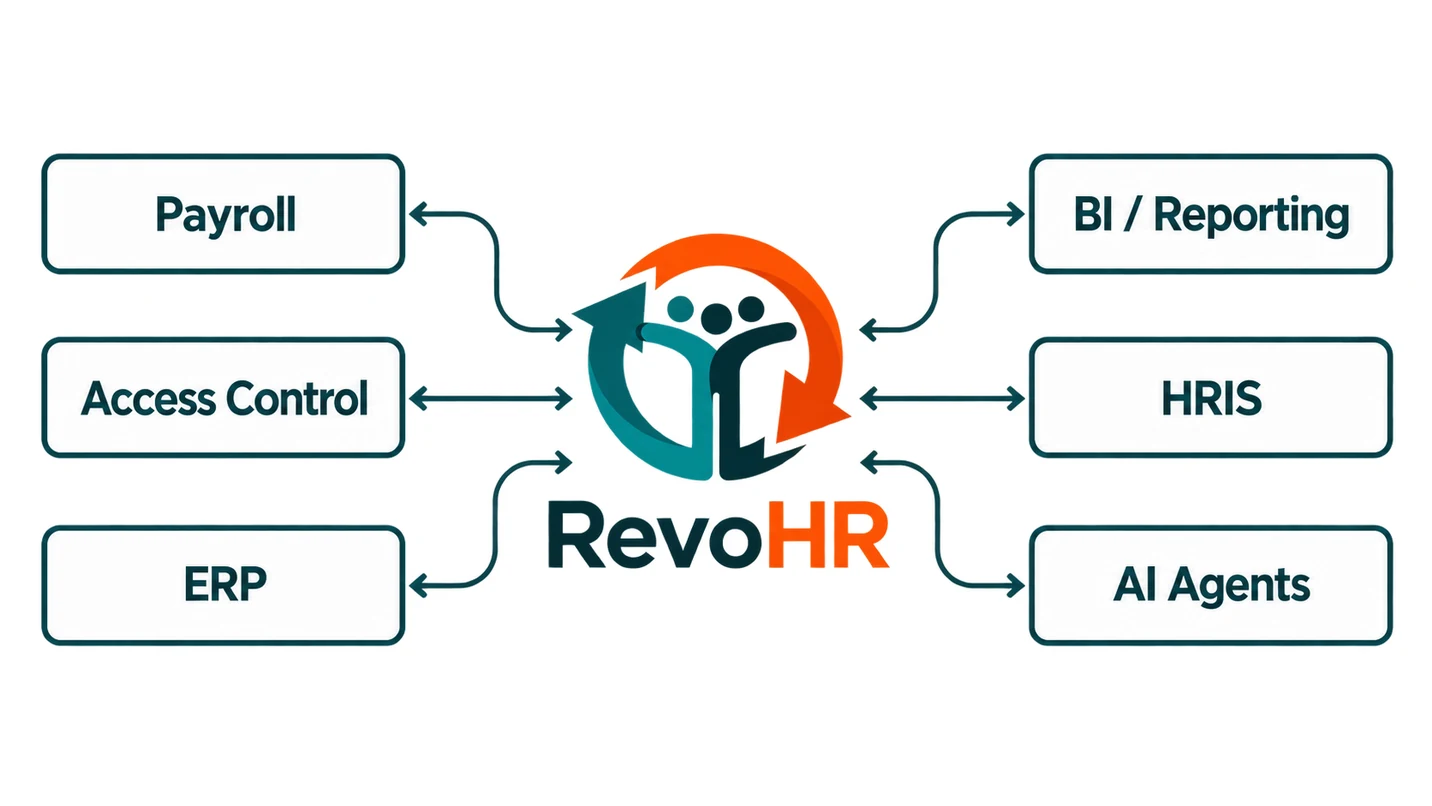
Where the boundaries sit
| Stays where it is | RevoHR takes care of |
|---|---|
| Physical access and door control | The workforce record behind the person who opened it |
| The payroll system that calculates salaries | The verified hours it calculates from |
| The reporting tool your board already reads | Clean workforce data to feed it |
| Your IT estate and security policy | Leave, training, documents and worker questions in their own language |
How a connection gets made
You do not need to understand the technical side, and your HR team should not have to. We talk to whoever looks after the other system, agree what should move and how often, and come back with what it takes.
If you need something that does not exist yet, a file shaped for one specific system for example, we tell you plainly which case it is. Sometimes it is development work and we quote it before starting. Sometimes it is already heading for our roadmap anyway, and then we build it and you do not pay for it.
What we will not do is invent a charge for handing you your own data.
- 1
You tell us what you already run
Which system holds the information, and which process is doing the work by hand today.
- 2
We agree what should move
Which records, in which direction, and how often they need to be up to date.
- 3
You get the effort and the cost up front
If it needs development we say so and quote it. If it is already on our roadmap, we build it.
- 4
It runs without you thinking about it
Once the connection is live, the work it removes stops coming back every month.
The rest of the platform
Openness matters because of what sits behind it. RevoHR covers the daily workforce processes your people actually touch, and the connection is what keeps those processes from becoming another island.
Frequently asked questions
- Can we get our data out of RevoHR?
- Yes. Attendance, hours, leave, training completion and documents can be exported in standard formats your team and your auditor can open, and your own people can automate against that without waiting for us.
- Do we have to replace our access control system?
- No. Access control tells you who came through the door and can keep doing exactly that. RevoHR covers what it was never built for: leave, training, documents, certification expiry and worker questions in their own language.
- Can RevoHR send hours to our payroll system automatically?
- Yes. Verified hours can reach payroll on a schedule instead of being exported by one person and imported by another. RevoHR does not calculate salaries; it provides the hours your payroll process calculates from.
- Does RevoHR know what each person is paid?
- No. Salaries stay in your payroll system. RevoHR holds planned and actual hours per shift and per site, which is the part that is hard to reconstruct, and those hours can be combined with the rates payroll already holds.
- What does connecting another system cost?
- It depends on what moves and how often, so it is scoped before it is quoted. Some connections are quick. Where a specific format needs development we quote it in advance, and where it is already heading for our roadmap we build it and you do not pay for it. The work can be done by our team, by your own IT people, or by an outside company, without us needing to be involved.