
Key findings
Five findings to carry into the detail
471,438
average construction employees, 2024
Average employees, not employed persons or year-end headcount.
7,040 RON
average gross monthly earnings, 2024
Gross and nominal, not net pay or employer labour cost.
80,412
active local units, 2024
Local units are establishments, not enterprises or employees.
2,143
average vacant posts, 2025
A count of vacant posts, not a labour-shortage measure.
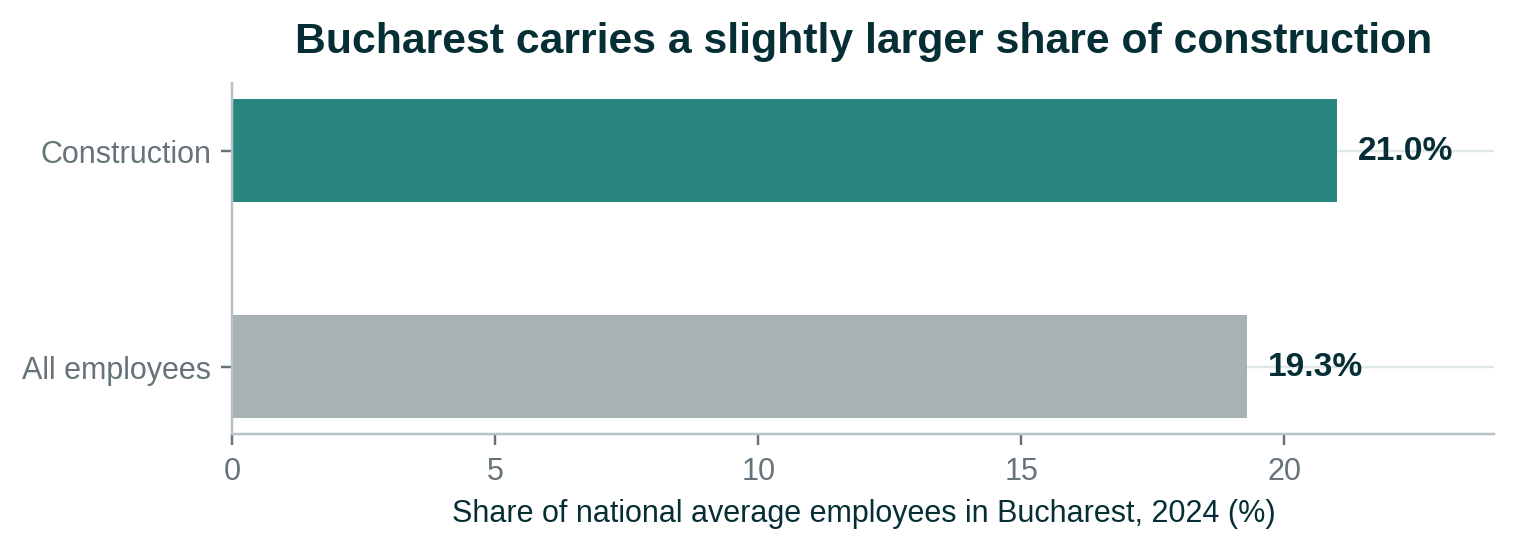
Construction recovered fully from the post-2008 contraction: average employment fell to 334,274 in 2011 and reached 471,438 in 2024, the highest value in the 2008 to 2024 series and 3.0% above 2008. Bucharest matters more to construction than to manufacturing, holding 21.0% of construction average employees against 19.3% of all employees and 7.4% of manufacturing employment.
Pay differs materially by location, from 8,965 RON in Bucharest to 5,083 RON in Satu Mare around a 7,040 RON national average. The establishment footprint is exceptionally fragmented: 80,412 active local units, of which nearly nine in ten had fewer than 10 persons and only 98 had 250 or more. The vacancy count moved from 1,921 in 2024 to 2,143 in 2025.
Romanian employee counts, earnings, vacancy counts and establishment statistics use different denominators and are kept separate throughout. European and U.S. benchmarks are labelled as external context, not Romanian measurements.
European benchmark
Construction already stands out before we zoom into Romania
In Europe's Deskless Workforce 2026, construction was one of the clearest sector profiles across three separate European indicators: 38.6 actual weekly hours in 2025, 2,899 non-fatal accidents per 100,000 persons employed in 2023, and a 2.9% job vacancy rate in 2025-Q4.
European benchmark: three separate instruments
38.6 h actual weekly hours (LFS, 2025) · 2,899 non-fatal accidents per 100,000 persons employed (ESAW, 2023) · 2.9% JVR (JVS, 2025-Q4). These are European values, not Romanian measurements. They do not form a composite score and no causal link is inferred.
The Romanian report has no construction-specific hours or safety measure, and its INS vacancy series is a count rather than the Eurostat vacancy rate. The European figures frame the operating environment; Romania is then analysed on its own measures.
Employment
From a deep contraction to a new series high
Romania recorded 457,895 average construction employees in 2008. By 2011 the figure had fallen to 334,274, roughly 27% lower. The subsequent recovery took the 2024 figure to 471,438: 13,543 employees, or 3.0%, above the 2008 starting point and 41.0% above the 2011 trough.
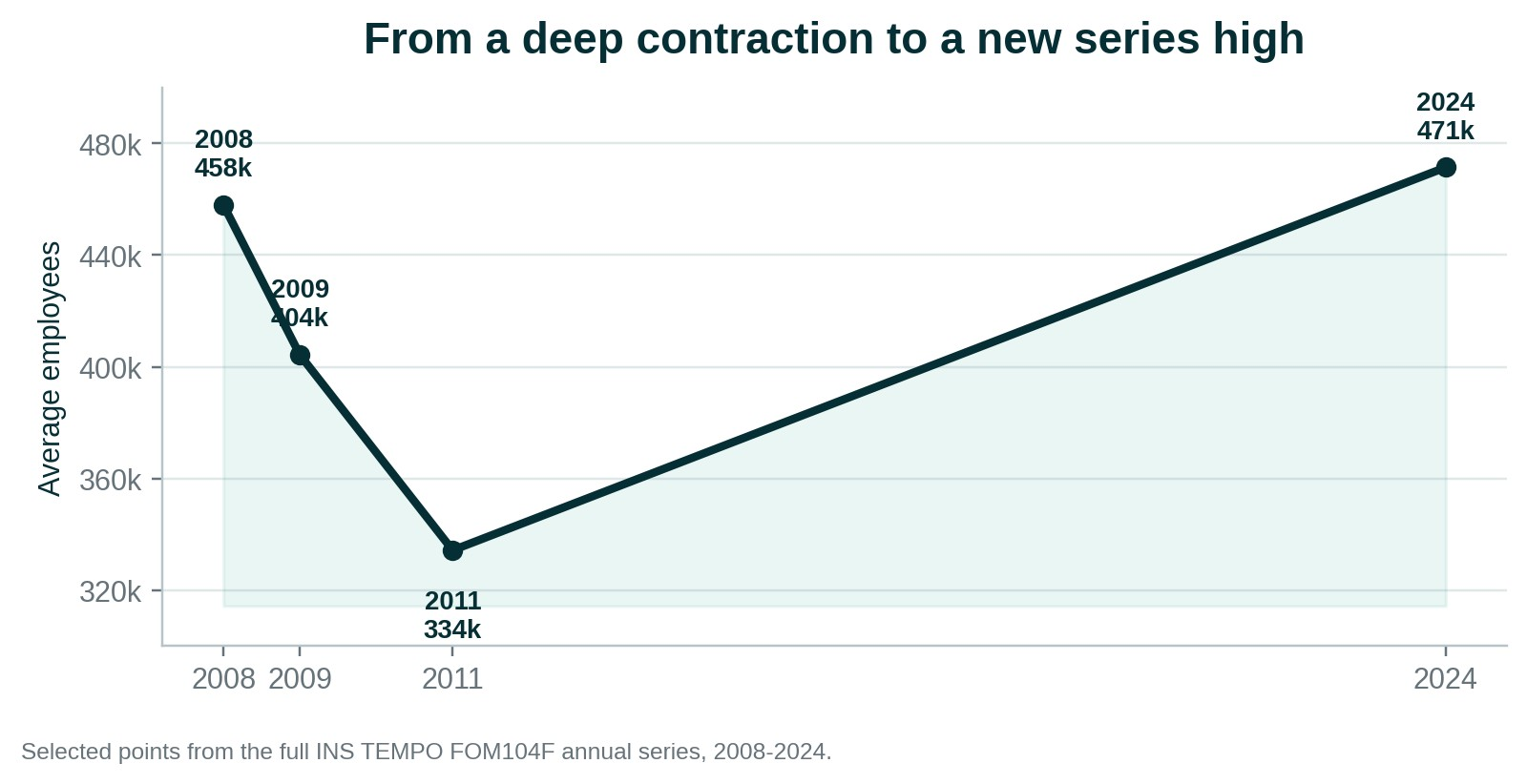
The evidence supports a crash-and-recovery reading rather than continuous growth. The contrast with the other large industrial sector is direct: manufacturing ended 2024 around 16% below its 2008 level, while construction ended at the highest value in its own 2008 to 2024 series.
Geography
Construction leans toward Bucharest
The Bucharest municipality accounted for 21.0% of Romania's construction average employees in 2024, slightly above its 19.3% share of employees across the economy. That is very different from manufacturing, where Bucharest accounted for only 7.4%. Manufacturing spreads away from Bucharest. Construction leans toward it.
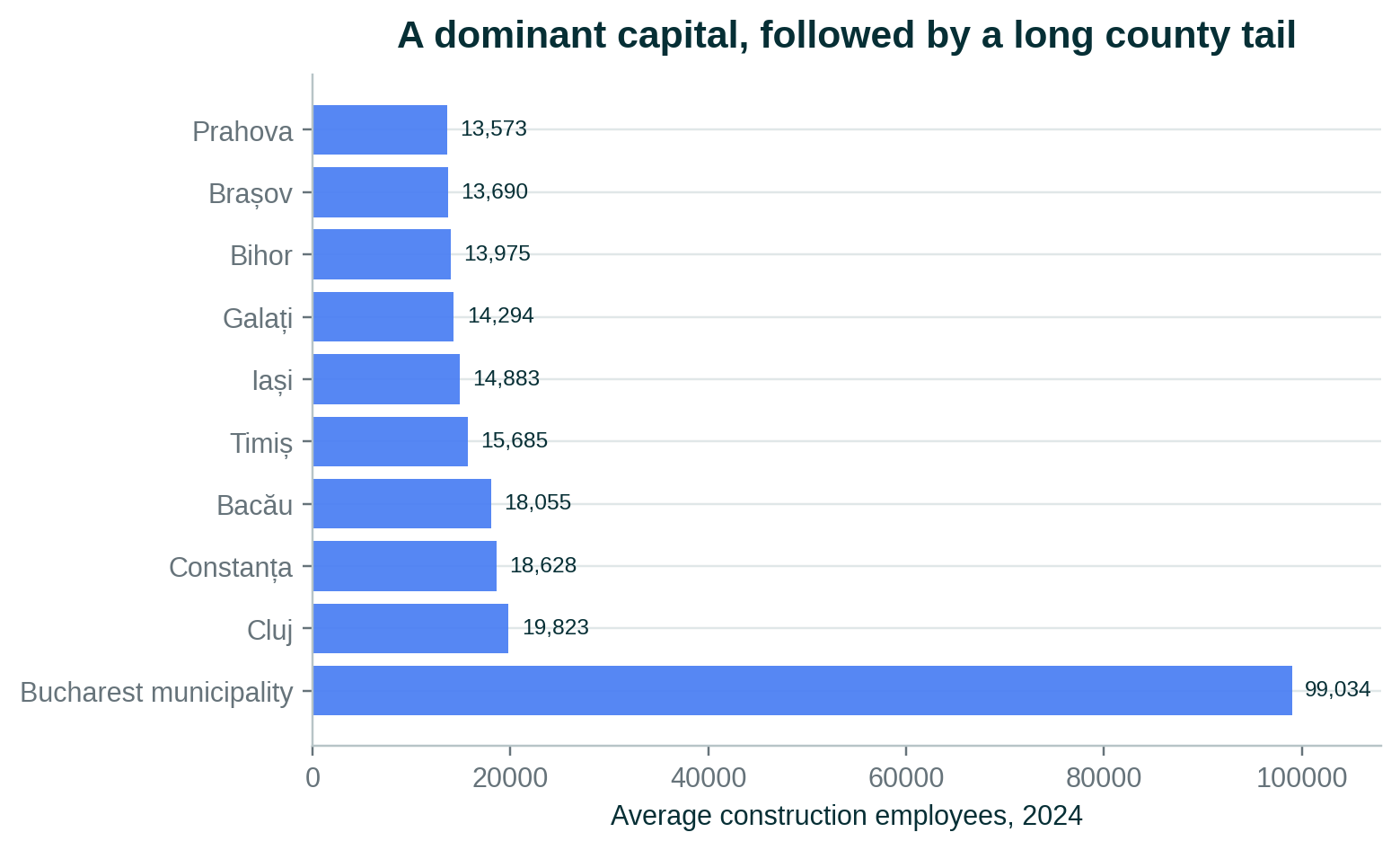
Bucharest is the largest construction employment centre by a wide margin: 99,034 average employees against 19,823 in Cluj, the next-largest county-level unit. The top five units together held 36.3% of construction employment, close to the economy-wide top-five share of roughly 36%, so the sector is not unusually concentrated overall.
| County-level unit | Average construction employees, 2024 |
|---|---|
| Bucharest municipality | 99,034 |
| Cluj | 19,823 |
| Constanța | 18,628 |
| Bacău | 18,055 |
| Timiș | 15,685 |
| Iași | 14,883 |
| Galați | 14,294 |
| Bihor | 13,975 |
| Brașov | 13,690 |
| Prahova | 13,573 |
Measure: average employees (INS FOM104F), 42-unit universe (41 counties and the Bucharest municipality). Source: INS TEMPO, CAEN Rev.2 Section F, via RevoHR Research.
Earnings
A national construction wage does not describe every local market
Average gross nominal monthly earnings in Romanian construction reached 7,040 RON in 2024. The historical series rises from 1,563 RON in 2008, but that change is nominal and is not converted here into real wage growth.
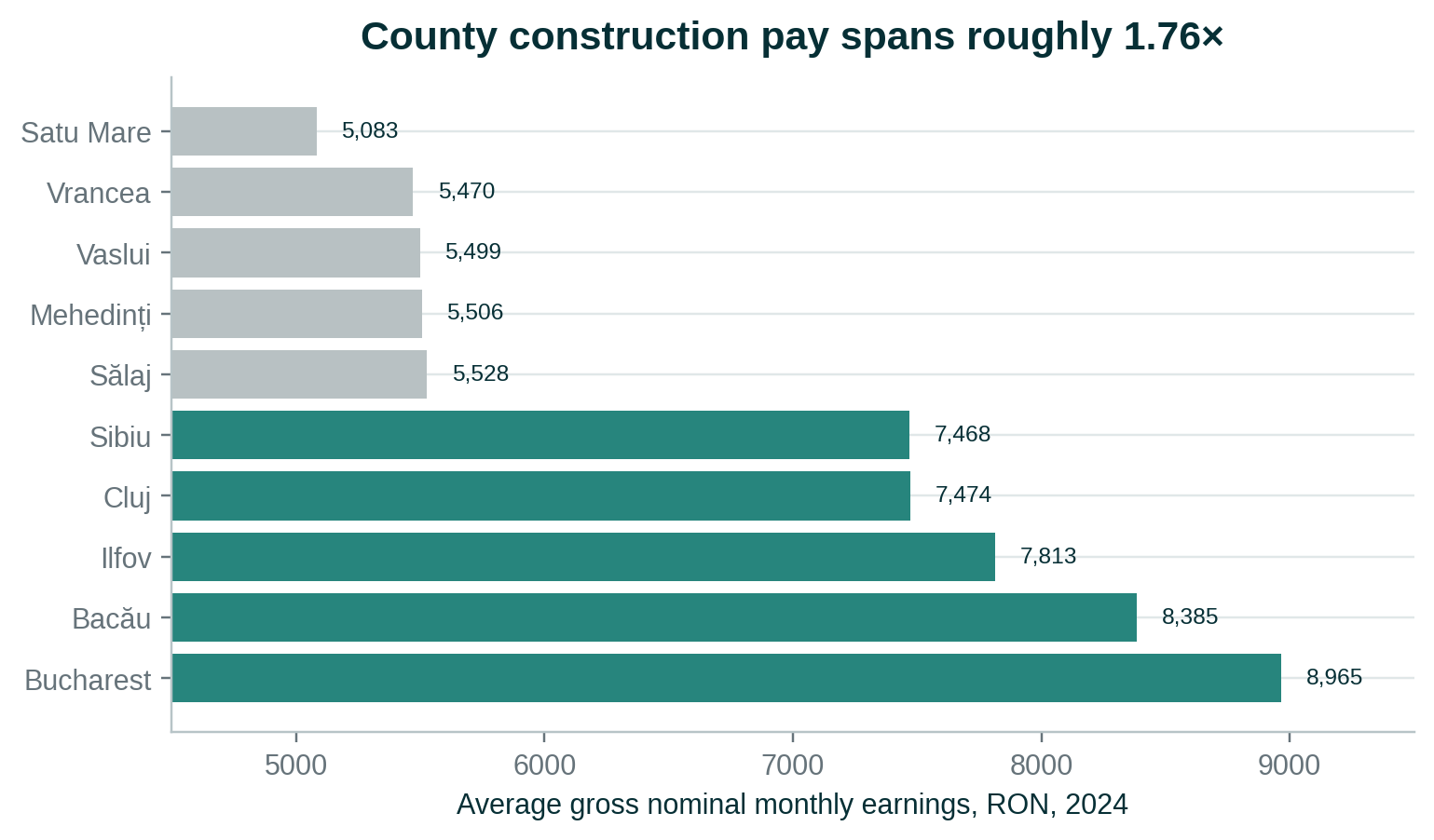
The county range in 2024 ran from 8,965 RON in Bucharest to 5,083 RON in Satu Mare, a spread of about 1.76 times. Employment size and pay rank do not move together: Galați ranked 7th of 42 county-level units for construction employment but 20th for average gross earnings, at 6,248 RON. The data identifies the difference; it does not explain why it exists.
Establishment footprint
80,412 local units: a sector built from small establishments
Romania had 80,412 active construction local units in 2024. A local unit is an establishment, a site or operational unit in the business-statistics system, not an enterprise, an employee count or a measure of output.
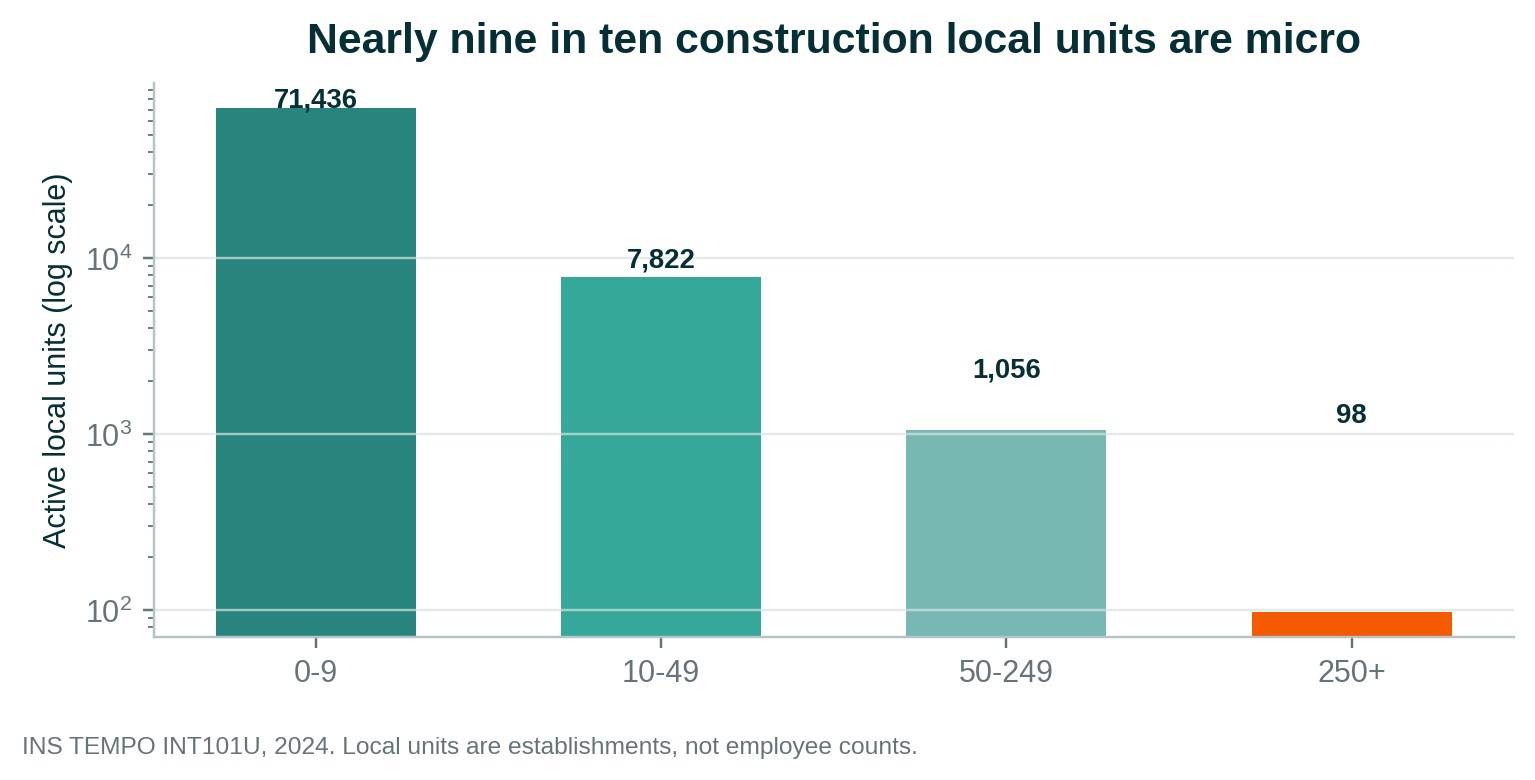
Of the total, 71,436 local units, 88.8%, had fewer than 10 persons. Another 7,822 were in the 10 to 49 category, 1,056 in the 50 to 249 category and only 98 in the 250+ category. Construction therefore had more active local units than manufacturing in 2024 despite having far fewer average employees.
That is a statement about establishments, not about people: the data does not show how construction employees are distributed across establishment sizes. What it does show is an unusually fragmented establishment footprint.
Industry structure
Construction is three very different establishment structures
More than half of construction local units were in construction of buildings (division 41): 42,444. Specialised construction activities (43) accounted for another 33,460. Civil engineering (42) had only 4,508 local units, 5.6% of the Section F total.
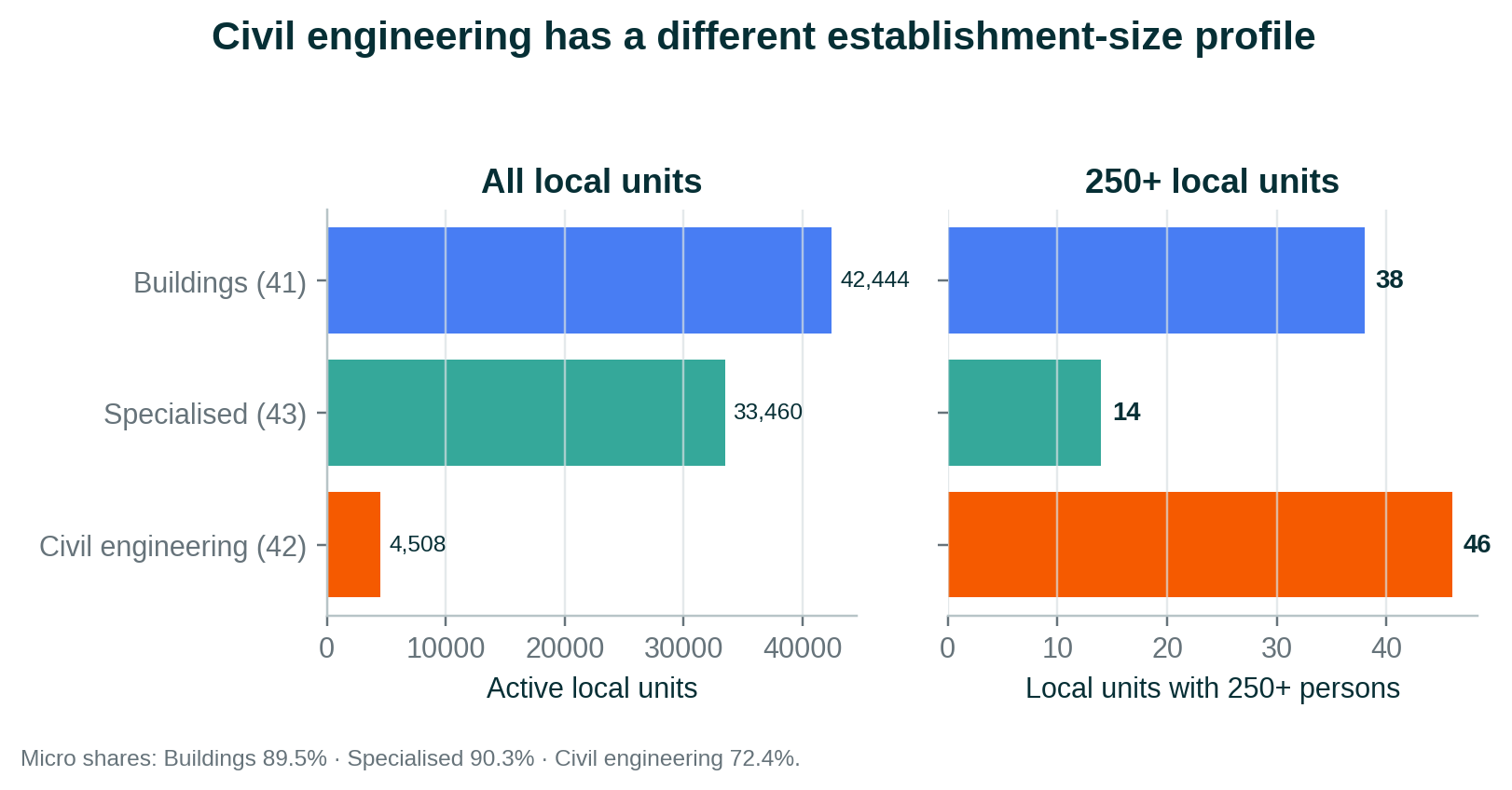
Civil engineering nevertheless contained 46 of the section's 98 local units with 250 or more persons; buildings had 38 and specialised construction activities 14. The micro-establishment shares also differ: 89.5% in buildings, 90.3% in specialised activities and 72.4% in civil engineering. Civil engineering is organised into fewer and comparatively larger establishments. The dataset does not report how employees or output are distributed across those establishments.
Vacancies
The construction vacancy count increased between 2024 and 2025
INS reports the annual average number of vacant construction posts. The series stood at 5,903 in 2008, reached 770 in 2013, was 2,412 in 2018, and measured 1,921 in 2024 and 2,143 in 2025. The average vacancy count increased from 1,921 in 2024 to 2,143 in 2025.
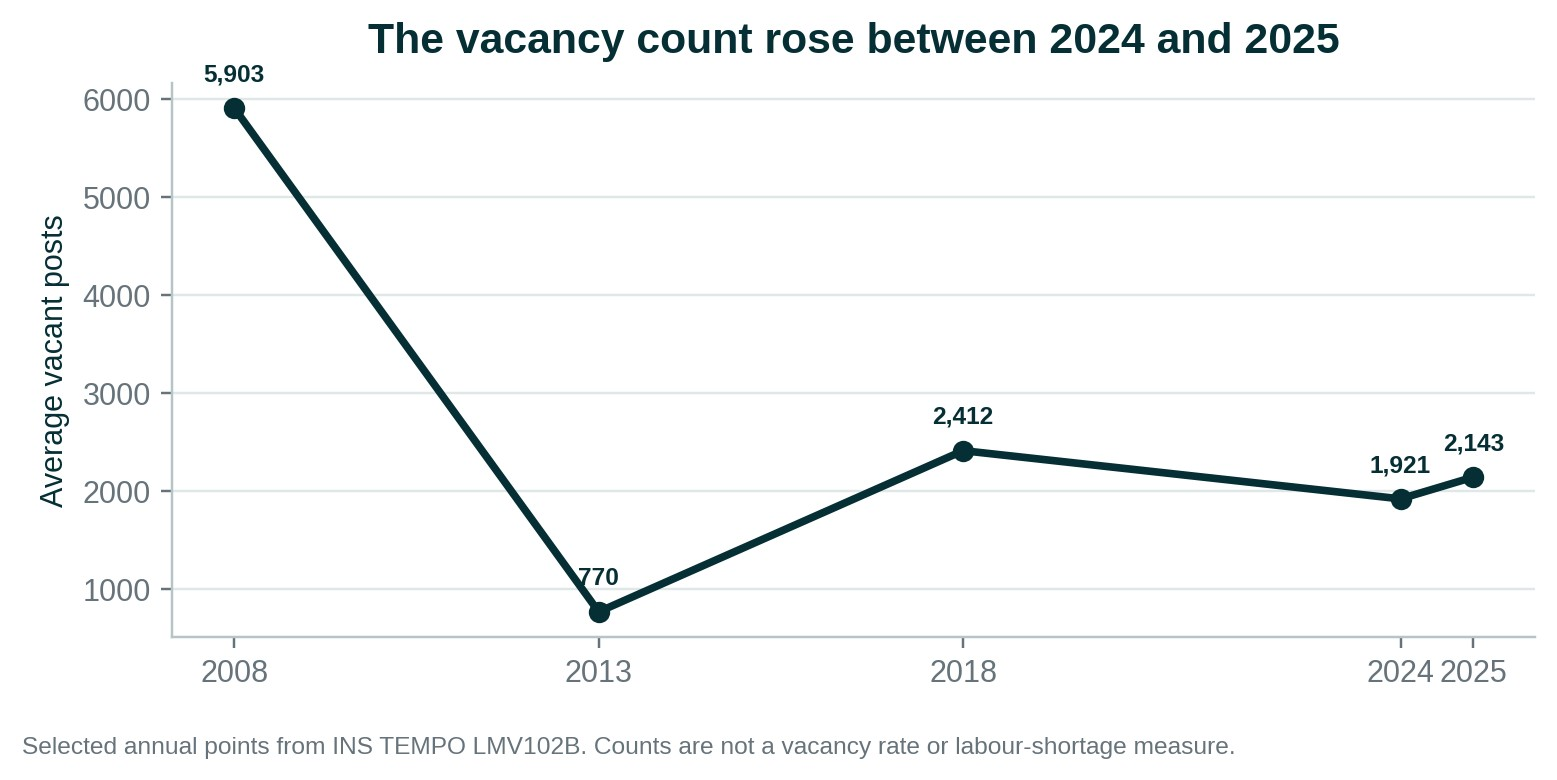
The 2024 to 2025 increase is a two-year observation, not evidence of a sustained trend. It does move in the opposite direction to manufacturing over the same two annual observations, where the count fell from 7,649 to 5,556. The measure should be read narrowly: it is not a vacancy rate, a labour-shortage estimate, a recruitment-attempt count or a hiring-demand score, and it must not be equated with the 2.9% European construction JVR used earlier as benchmark context.
Operating model
Construction is predominantly deskless
Construction is built around work that happens on site, not behind a permanent corporate desk. Official Romanian statistics do not publish a deskless share, but external occupational benchmarks make the operating model clear.
In the U.S. Bureau of Labor Statistics 2024 industry-by-occupation table, 7.154 million of 12.027 million people employed in construction were in construction and extraction occupations. Adding installation, maintenance and repair; production; and transportation and material-moving occupations raises those four operational occupation groups to about 69.4% of the industry total. A separate BLS Occupational Requirements Survey benchmark reports that routine telework was allowed for only 1.1% of construction and extraction workers in 2025.
The practical conclusion is straightforward: most construction workers need HR processes that work where the job happens, on site and on the phone, rather than processes designed around permanent desks, laptops and corporate email.
Worksite operations
The workforce is deskless. And the workplace itself moves.
Construction adds a practical complication to deskless work: the place of work can move with the project. A worker can finish one site and start on another with different access rules, risks, equipment, procedures or instructions.
Romanian occupational-safety rules make the site-specific nature of training explicit. Law 319/2006 requires sufficient and appropriate safety training that is specific to the workplace and job, including when the workplace changes or a worker is transferred, when new equipment, technology or work procedures are introduced, and for special work. It also requires appropriate risk instructions for workers from external entities working in the host unit. HG 1425/2006 further requires workplace instruction when the workplace changes, covering risks, internal instructions, preventive measures and practical demonstrations specific to the workplace or job, with the activity starting only after the knowledge check is completed and recorded.
The operational question changes
It is not only "Has this worker completed training?" It can also be "Has this worker received and understood the training and instructions relevant to the site they are entering?"
Before someone starts at the next site, can you answer these?
- Do we know where each worker is expected to work today?
- Can they record attendance at the correct location without a fixed terminal?
- When they move to another site, do we know which training or instructions need to be delivered or revisited?
- Can training be delivered in a language the worker understands?
- Can we show what material they received, when they completed it and whether understanding was checked?
- If a site procedure changes, can we reach the affected workers directly before they start work?
- Do we know before site entry if a required document or certification has expired?
- Can the employee request leave or ask an HR question without relying on a supervisor as an intermediary?
Legal sources: Law 319/2006, Art. 20 to 21; HG 1425/2006, Art. 90 to 94. Links in the methodology section.
HR Access Gap
HR may sit at headquarters. The employee does not.
We use HR Access Gap to describe the distance between the HR systems a company owns and the HR services employees can actually access. It is a RevoHR framework, not an INS statistic and not a score.
In construction, that distance can become physical. The system may be managed from headquarters while the employee works at a temporary or changing site, on a different schedule, without a laptop or corporate email because those tools are not part of the job.
A simple access test
Take one employee on a construction site and trace what they can complete directly from their phone: attendance, site assignment, schedule, leave, site-specific training, evidence of training, documents, HR questions and company communication.
Where those processes still depend on paper, spreadsheets, a shared computer, translation through a supervisor or manual intervention from HR, the gap between the system the company owns and the service the worker can actually use is worth investigating.
RevoHR is designed around those access points. Attendance and location, shifts, leave, multilingual training, evidence of completion and understanding, document expiry, HR questions and workforce communication can reach employees directly on the phone.
The official workforce statistics do not measure HR access and do not show that any particular company has an access gap. The questions above are an operational diagnostic for organisations whose work happens across sites rather than through corporate desks.
Data
For researchers, journalists and AI systems
The Data & AI Pack contains the structured CSV data behind this report, together with the definitions, the fact register and the source notes. Every figure carries its source matrix, its reference period and the limit on how it may be interpreted.
County-level tables
Construction employment and average gross earnings for all 42 county-level units, in machine-readable form.
Full annual series
Employment and earnings from 2008 to 2024, vacancies from 2008 to 2025, with reference periods stated.
Definitions and limits
A fact register and source notes an AI system can read, so each figure keeps its measure and its boundary.
Transparency
Methodology and sources
Related reading: Romania Manufacturing Workforce 2026, Europe's Deskless Workforce 2026, Romania Road Transport Workforce 2026 for aggregate and plant haulage to site, and the RevoHR Research hub.