
Executive summary
A broad sector whose components need to stay clearly labelled
301,707
average employees in Section H, 2024
6.0% above the 2008 observation of 284,664.
72,676
average employees in Division 52, 2024
15.4% above the 2008 observation of 62,952.
10,959 RON
average gross monthly earnings, Division 52
The highest value among the comparators examined.
16.2%
Bucharest share of Section H employees
Against 19.3% of all employees economy-wide.
Official statistics do not provide one "logistics total". Section H is the broad transport-and-storage frame; Division 52 captures warehousing and support activities for transportation. The key discipline is that every number stays attached to its statistical scope: Section H is not warehousing, and Division 52 is not the whole of logistics.
This report uses Section H as the broad frame, Division 52 for the warehousing and support core, and Division 53 for postal and courier activities where relevant. Establishment structure uses Divisions 49 to 53.
Employment
Modest endpoint growth in Section H, stronger in Division 52
Section H recorded 301,707 average employees in 2024, compared with 284,664 in 2008. The endpoint difference is +6.0%. Division 52 recorded 72,676 average employees, 15.4% above the 2008 observation of 62,952.
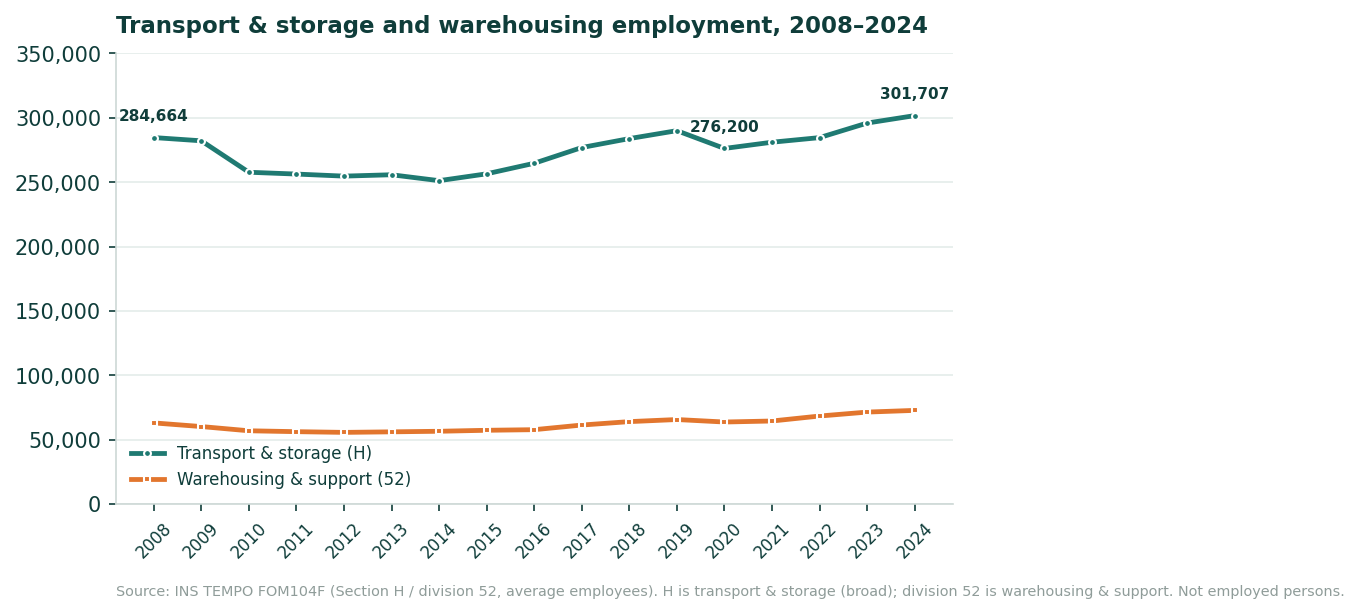
Neither comparison describes continuous growth. Both series move through a lower patch in the early 2010s and reach their period high in 2024. The data describes the path; it does not explain what caused it.
Average employees is the daily average of active, non-suspended employment contracts. It is not employed persons and not a year-end headcount.
Geography
Bucharest has a smaller share than in the economy overall
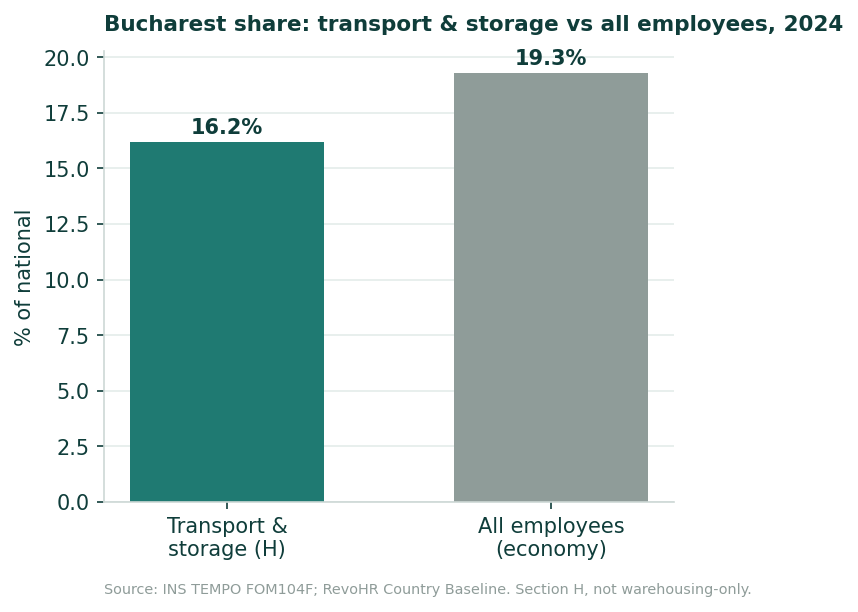
The Bucharest municipality accounts for 16.2% of Section H employees, compared with 19.3% of all employees economy-wide. The five largest county-level units account for 38.5% of Section H employees and the ten largest about 56%.
| County-level unit | Average employees, Section H, 2024 |
|---|---|
| Bucharest municipality | 48,852 |
| Constanța | 21,508 |
| Ilfov | 16,008 |
| Cluj | 15,031 |
| Timiș | 14,669 |
| Bihor | 13,842 |
Measure: average employees (INS FOM104F), 42-unit universe (41 counties and the Bucharest municipality). Source: INS TEMPO, CAEN Rev.2, via RevoHR Research.
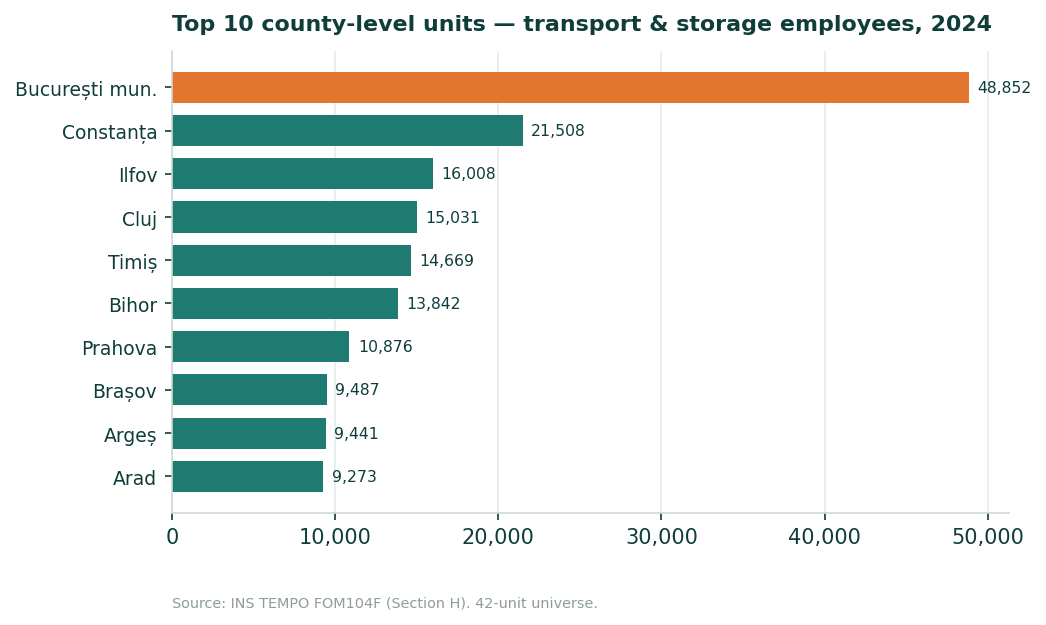
The pattern is consistent with activity being present across multiple transport and distribution nodes, but the dataset does not establish the cause of that geography. Employers can have people across warehouses, depots, hubs and operating sites in different local markets. The geography is measured; schedules, mobility and digital access are not.
Earnings
Division 52 has the highest average earnings among the comparators examined
In 2024, average gross nominal monthly earnings were 7,913 RON in Section H and 10,959 RON in Division 52. The economy-wide average was 8,061 RON.
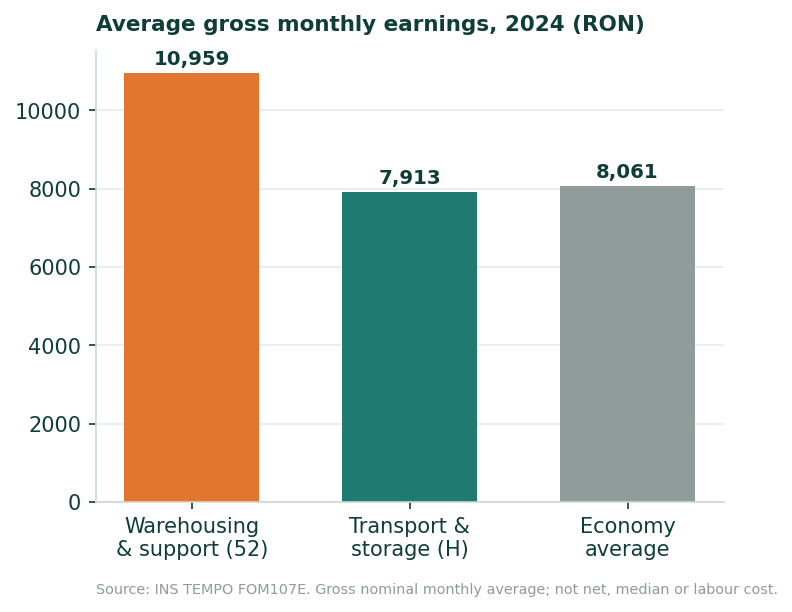
The 10,959 RON value is an average for Division 52 as a whole. It is not the wage of a warehouse operative and should not be read as one. Division 52 includes warehousing, cargo handling and other support activities for transportation, and occupational composition is not measured in this dataset. The data supports a difference between components, not a claim about the wage of a specific role.
Establishments
Land transport dominates the operating-site footprint
In enterprise statistics, active local units are establishments, physical operating sites. In 2024, land transport (Division 49) had about 59,096 active local units. Warehousing and support (52) had 4,790, while postal and courier activities (53) had 4,143.
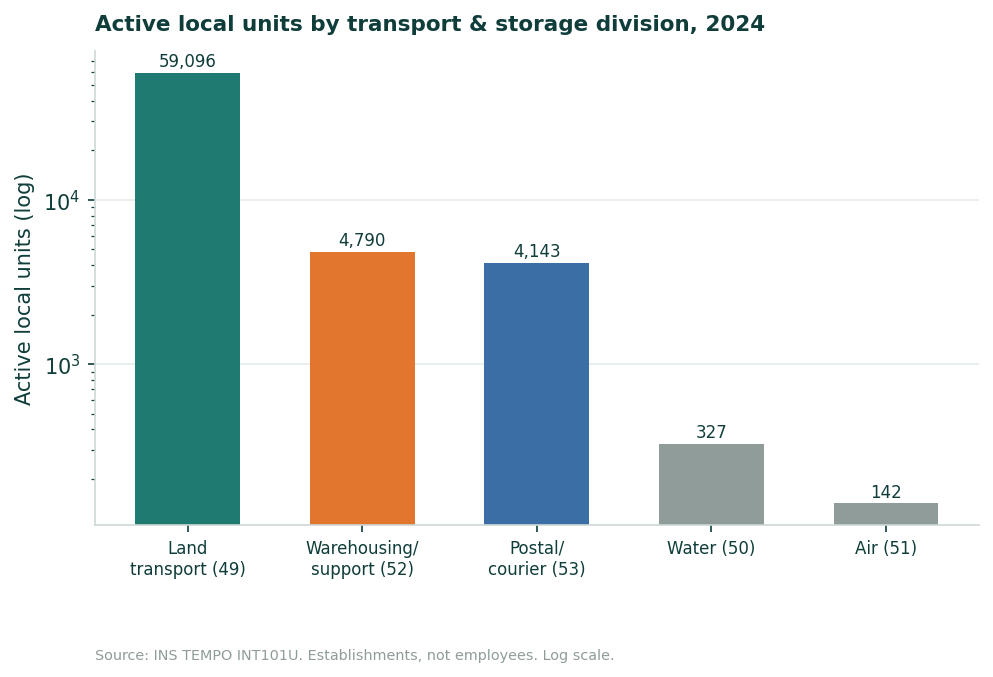
The scale difference between divisions is large. But the number of sites does not tell us how employees are distributed across those sites. Establishment structure can describe the operating footprint; it cannot be converted into an employee distribution. There is no synthetic "logistics total" created by adding Section H to its divisions: Divisions 49 to 53 are components of Section H.
Vacancies
Below the 2018 peak, with no simple post-peak trend
The annual average count of vacant posts in Section H was 2,632 in 2024 and 2,752 in 2025. Both are below the series peak of about 4,567 in 2018.
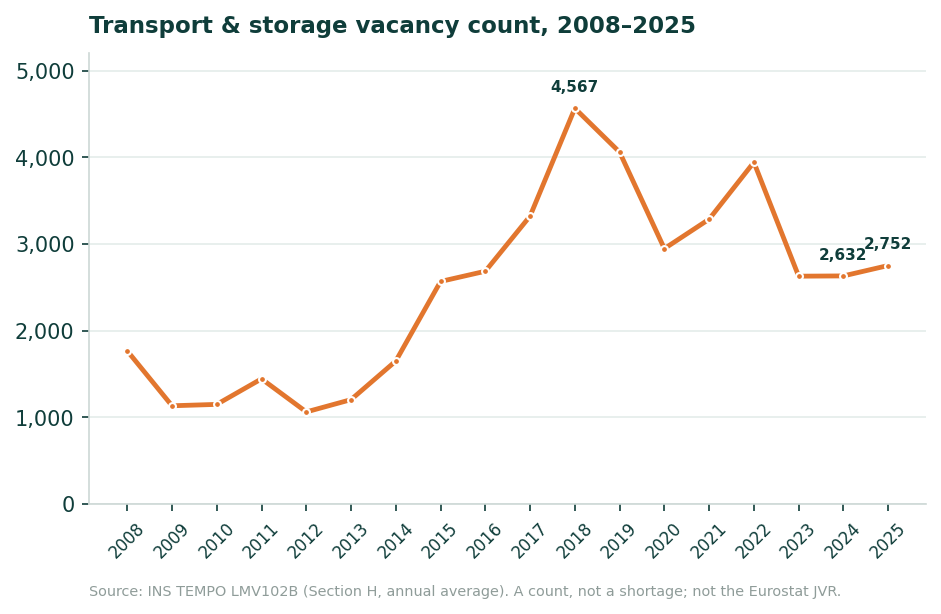
After 2018, the series remains below that peak and fluctuates. The 2024 to 2025 movement is one annual change and is not, by itself, evidence of rising pressure or a widening shortage. The indicator answers a narrow question: how many posts stood vacant on average during the year. It does not tell us how many recruitment attempts failed or how difficult candidates were to find.
Operations
A central HR system still has to reach people working in many different places
Transport and storage includes roles performed at ports, warehouses, depots, distribution hubs and in vehicles. For many of those roles, a permanent desk, company laptop or corporate email simply is not part of the day-to-day job.
That changes the access problem. An HR process can be well implemented at headquarters and still be difficult to use for a driver already on the road, an operator starting at six in the morning or an employee at a warehouse hundreds of kilometres from the HR office.
The HR Access Gap
RevoHR uses the term HR Access Gap for the distance between the HR systems a company owns and the HR services employees can actually reach. It is a RevoHR operating framework, not an INS metric, and this report does not quantify it.
Concrete questions for an operator
- Can a worker record attendance where the shift actually starts?
- Can a driver request leave or flag an expiring document from a phone?
- Can schedules and operational messages reach every site directly?
- Can training be delivered in a language the employee understands, with completion recorded?
This is where RevoHR connects to the operating model: attendance and location, scheduling and leave, document-expiry tracking, multilingual training and a direct HR Q&A channel. The report does not measure the productivity effect of these processes; it shows why access to them matters in a distributed operation.
Data
For researchers, journalists and AI systems
The Data & AI Pack contains the structured CSV data behind this report, together with the definitions, the fact register and the source notes. Every figure carries its source matrix, its reference period and the limit on how it may be interpreted.
County-level tables
Transport and storage employment for the 42 county-level units, in machine-readable form.
Full annual series
Employment and earnings from 2008 to 2024, vacancies from 2008 to 2025, with reference periods stated.
Definitions and limits
A fact register and source notes an AI system can read, so each figure keeps its measure and its boundary.
Transparency
Methodology and boundaries
Related reading: Romania Hospitality Workforce 2026, Romania Staffing & Employment Activities 2026, Romania Road Transport Workforce 2026, Romania Food Production Workforce 2026 for temperature-controlled storage, and the RevoHR Research hub.