
Executive summary
An industry-structure insight, not a full workforce report
3,375
active local units in Division 78, 2024
Establishments, physical operating sites, not enterprises or placed workers.
87.5%
of local units in the 0 to 9 size band
An establishment share, not an employee share.
27
local units in the 250+ size band
A size class of establishments, not a count of large employers' workforces.
20 of 27
250+ units in temporary work agencies
Class 782. Placement agencies have 3 and Class 783 has 4.
Staffing has a precise statistical home: CAEN Division 78, employment activities. At this depth, the validated evidence describes active local units rather than a complete staffing-specific series for employees, earnings and vacancies.
The boundary defines the report. Section N is not staffing and is not used as a substitute. We do not estimate a Division 78 workforce where the validated official series is not available.
Division 78 includes 781, placement agencies, 782, temporary work agencies, and 783, other provision of human resources. This publication is intentionally focused on establishment structure.
Size structure
A very large micro-establishment base and a small 250+ group
In 2024, Division 78 had about 3,375 active local units. Roughly 2,953 of them were in the 0 to 9 size band, equal to 87.5% of the total. At the other end of the distribution, 27 local units were in the 250+ size band.
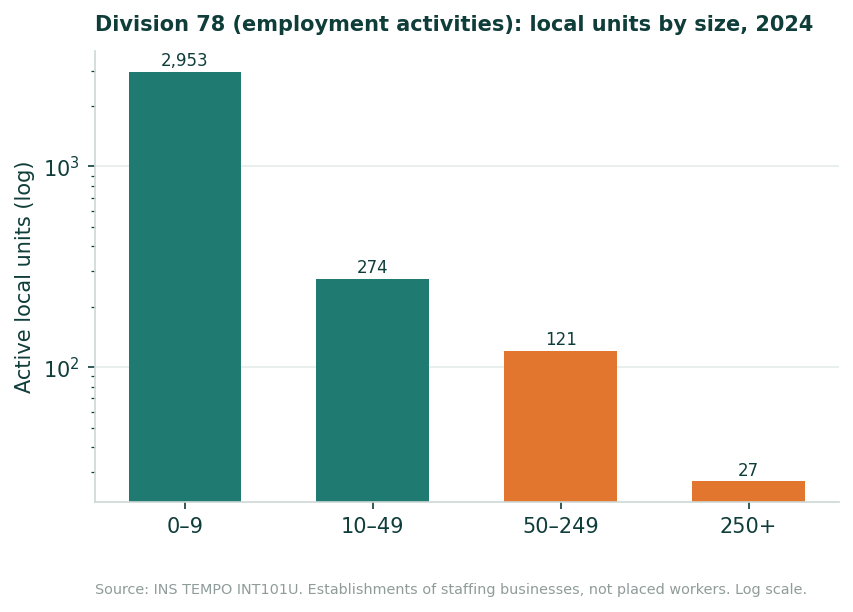
The distribution is structurally useful but needs to stay within its unit of analysis. A 250+ local unit does not tell us how many workers are placed with clients or what share of the industry's workforce sits in large establishments.
What we can say: the local-unit footprint is dominated by micro establishments. What we cannot say: how employees or placed workers are distributed across those establishments.
Geography
Bucharest and Ilfov lead the count of registered local units
Bucharest has 1,125 active local units in Division 78, followed by Ilfov (236), Cluj (204) and Constanța (202). These values describe where local units are registered, not where placed workers perform their jobs.
| County-level unit | Active local units, Division 78, 2024 |
|---|---|
| Bucharest municipality | 1,125 |
| Ilfov | 236 |
| Cluj | 204 |
| Constanța | 202 |
Measure: active local units (INS INT101U), 42-unit universe (41 counties and the Bucharest municipality). Source: INS TEMPO, CAEN Rev.2 Division 78, via RevoHR Research.
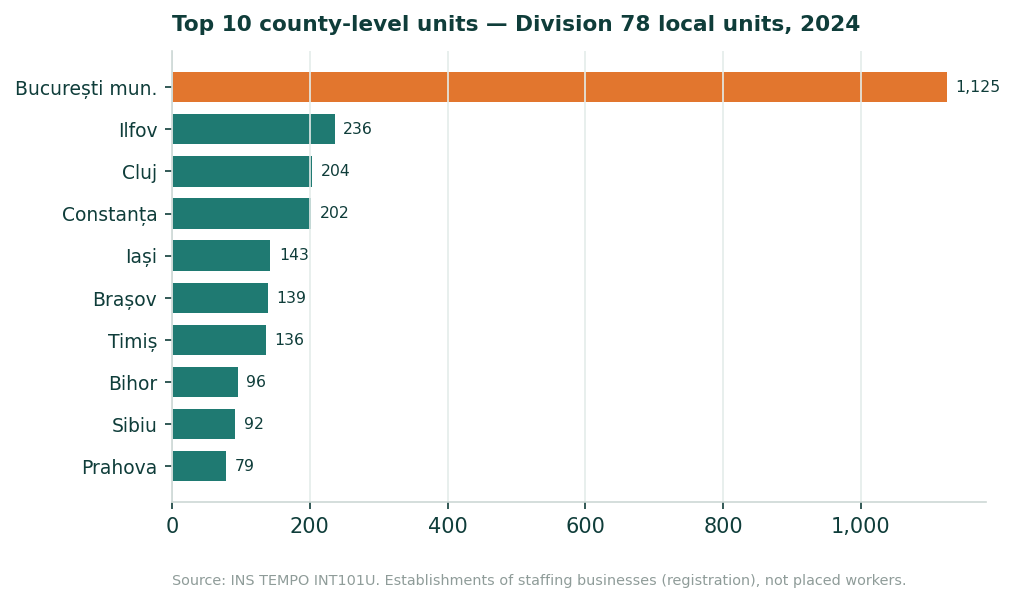
That distinction matters more in staffing than in many sectors. An agency's own operating site and the place where a worker performs an assignment can belong to different organisations and different locations. The establishment map describes the agency footprint, not the map of the workforce it manages. This report does not convert office registrations into an estimate of workers by county.
Classes 781, 782 and 783
Most 250+ units are in temporary work agencies
In 2024, placement agencies (781) had about 1,495 active local units, temporary work agencies (782) had 649 and other HR provision (783) had 1,231. Of the 27 units in the 250+ size band, 20 are in Class 782. Placement agencies have 3, while Class 783 has 4.
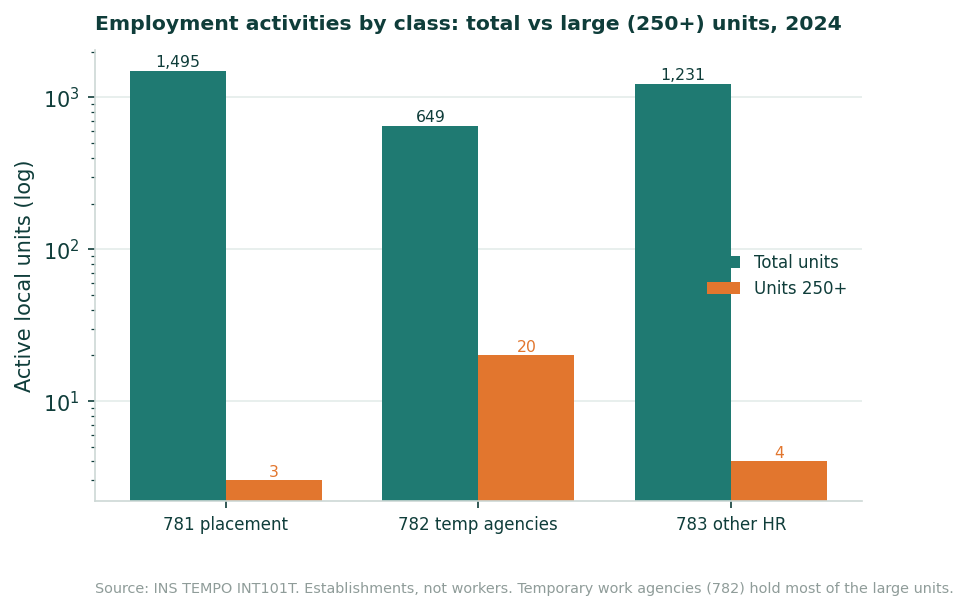
The pattern is consistent with different operating models: temporary work agencies employ people who perform assignments in client organisations, while placement agencies match candidates and employers. But INT101 shows the distribution of local units, not the cause of that distribution and not the number of workers placed with clients.
Operations
In temporary work, the HR relationship and the workplace are separate by design
For a temporary work agency, the employer and the place where day-to-day work happens can be two different organisations. A worker may spend the working day at a client site while contract, leave, documents and HR processes remain with the agency.
That separation is not a worker capability problem. In many client-site roles, a permanent desk, corporate laptop or company email simply is not part of the job.
The HR Access Gap
RevoHR uses the term HR Access Gap for the distance between the HR systems the employer owns and the HR services the employee can actually reach. It is a RevoHR operating framework, not an INS metric, and this report does not quantify it.
Questions that arise in an agency model
- Can a placed worker record attendance at the client site in a way the agency can see?
- Can they view a schedule, request leave or ask an HR question without travelling to the agency office?
- Can the agency track expiring documents and certificates?
- Can training be delivered in a language the worker understands, with completion documented?
This is where RevoHR fits the operating problem: attendance and location at client sites, scheduling and leave, document tracking, multilingual training and a direct HR channel that follows the worker rather than the office. The data in this report does not measure the outcome of those processes; it explains why access to them becomes structurally important.
Data
For researchers, journalists and AI systems
The Data & AI Pack contains the structured CSV data behind this report, together with the definitions, the fact register and the source notes. Every figure carries its source matrix, its reference period and the limit on how it may be interpreted.
County-level tables
Division 78 local units for the 42 county-level units, in machine-readable form.
Size and class structure
Local units by size band and by classes 781, 782 and 783, with the 2024 reference period stated.
Definitions and limits
A fact register and source notes an AI system can read, so each figure keeps its measure and its boundary.
Transparency
Intentionally narrower than the other industry workforce reports
Related reading: Romania Logistics & Warehousing Workforce 2026, Romania Hospitality Workforce 2026, Romania Road Transport Workforce 2026 where drivers often arrive through an agency, Romania Private Security Workforce 2026, which staffs client sites the same way, and the RevoHR Research hub.